Research Use Only · Dosing data compiled from published literature · Not for human or veterinary use
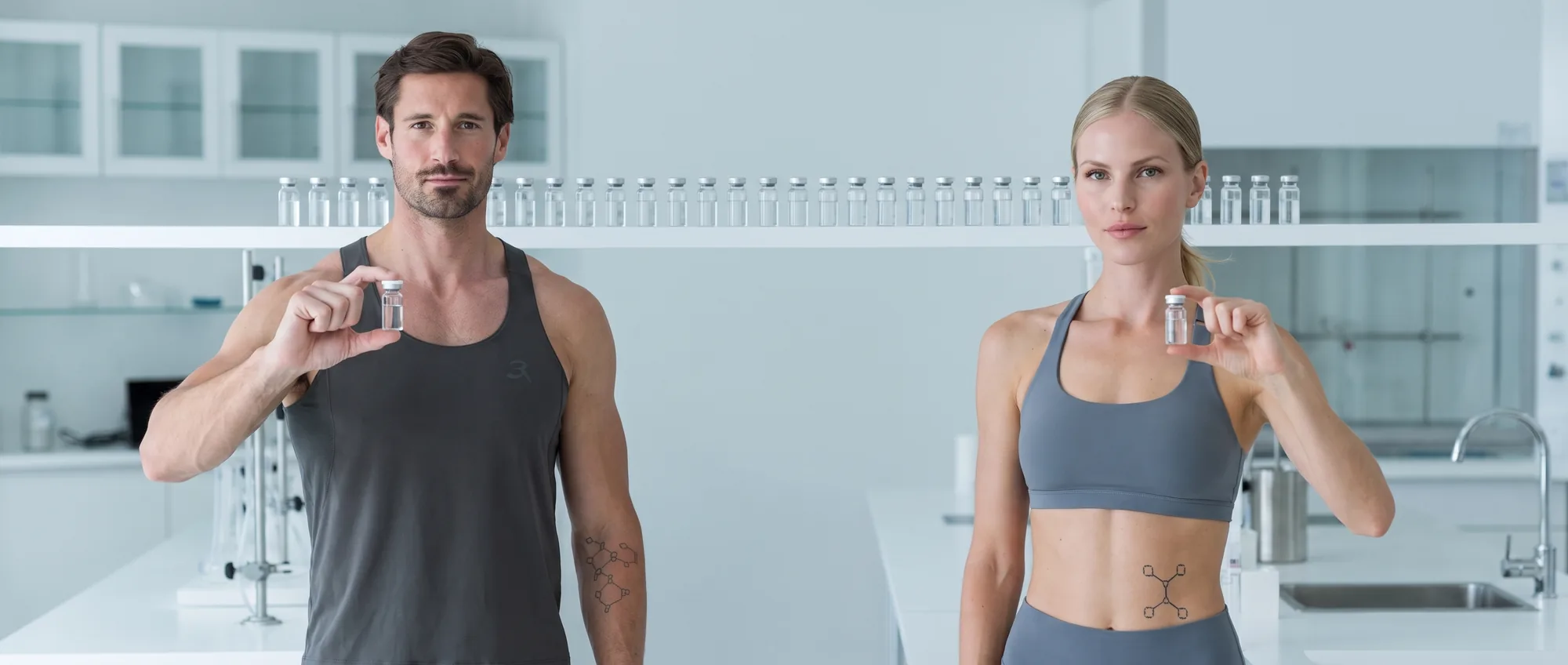
Two researchers in a laboratory each holding a 3 mL peptide vial, shelves of vials behind them
72 Compounds · Sourced Dosing Ranges

Research with confidence.

Answer three questions and we'll tell you exactly how much water to put in your vial and what number to draw to on the syringe. No working anything out yourself.

72Compounds
125Cited Studies
10Categories
0Sponsored Claims
Start Here Three questions
  1. 1Compound
  2. 2Vial
  3. 3Water
  4. 4Doses
Which peptide do you have?

Pick it from the list. It's on the label of your vial.

Browse by type

72 peptides, sorted into 11 groups.

3 compounds

Tissue Repair & Recovery

BPC-157, TB-500, KPV

View class →
11 compounds

Metabolic / Incretin

Semaglutide, Tirzepatide, Retatrutide, Cagrilintide, +7 more

View class →
9 compounds

GH Secretagogue

Ipamorelin, CJC-1295 (no DAC), CJC-1295 DAC, Sermorelin, +5 more

View class →
4 compounds

Growth Factor

IGF-1 LR3, IGF-1 DES, MGF, PEG-MGF

View class →
12 compounds

Longevity & Bioregulator

Epitalon, Pinealon, Vilon, Livagen, +8 more

View class →
4 compounds

Mitochondrial

NAD+, MOTS-c, SS-31, Glutathione

View class →
6 compounds

Cognitive & Neuro

Semax, Selank, Cerebrolysin, DSIP, +2 more

View class →
4 compounds

Immune & Anti-microbial

LL-37, Thymosin Alpha-1, VIP, PNC-27

View class →
3 compounds

Cosmetic & Dermal

GHK-Cu, Melanotan II, SNAP-8

View class →
5 compounds

Endocrine & Sexual Health

PT-141, Kisspeptin-10, Gonadorelin, Oxytocin

View class →
10 compounds

Multi-Compound Blends

GLOW Blend, KLOW Blend, Wolverine Blend, BPC-157 / KPV Blend, +6 more

View class →
Methodology

Where the numbers come from

Dose ranges on this site are pulled from three tiers of evidence, and we label which tier a compound sits in rather than flattening them together:

  • Clinical trial data — registered human trials with published dose-escalation arms (the GLP-1 class, tesamorelin, elamipretide, bremelanotide).
  • Preclinical research data — where only weight-based research dosing exists, we say so and give the reported mg/kg rather than implying a human equivalent.
  • Observational and grey literature — commonly reported research-community ranges, flagged explicitly as low-confidence.

See every citation in the Research Library →

Evidence tiers at a glance

TierCompoundsMeaning
Clinical27Human trial dosing published
Preclinical30Preclinical research only
Limited15Sparse or community-reported

All 72 peptides

Every compound has its own page with a prefilled calculator, the doses used in research, a week-by-week plan and the studies behind it.

Common questions

The things people ask most often before they mix their first vial.

How do I reconstitute a peptide?

Let the vial reach room temperature, swab the stopper, then draw your bacteriostatic water and angle the needle so the stream runs down the inner wall of the vial rather than jetting onto the powder. Let the vacuum pull it in, then swirl gently or leave it to dissolve. Never shake it — agitation shears peptide chains. Wait until the solution is completely clear before using it.

How much bacteriostatic water should I add?

It is a free choice, and it is the only lever you have over measurement precision. More water means a weaker solution and a larger, easier-to-read draw. A 5 mg vial in 1 mL puts a 250 mcg dose at 5 units, where half a unit of error is a 10% dosing error. The same vial in 2.5 mL puts it at 12.5 units, where the same slip matters far less. Aim for your usual dose to land in the middle of the barrel.

What does a unit mean on an insulin syringe?

A unit is a volume, not an amount of peptide. On a standard U-100 syringe, 1 unit is 0.01 mL. Ten units drawn from a weak mix and ten from a strong one fill the barrel to exactly the same line, but one holds several times more peptide. That is why a calculator has to know what you put in the vial before it can tell you what to draw.

How do I work out how many doses are in a vial?

Divide the total peptide in the vial by your dose. A 5 mg vial dosed at 250 mcg gives 20 doses, because 5 mg is 5000 mcg and 5000 divided by 250 is 20. The amount of water you add does not change how many doses you get — only how much liquid each one is.

How long does a peptide last after mixing?

Lyophilised powder kept sealed at −20 °C is generally stable for a year or more. Once reconstituted with bacteriostatic water and refrigerated at 2–8 °C, most compounds are considered usable for roughly two to four weeks, though this varies. Sterile water without preservative is much shorter, usually a single session. Never freeze a reconstituted vial.

What is the difference between mg, mcg and IU?

A milligram is 1000 micrograms. An international unit is different again — it measures biological activity rather than mass, and the conversion to milligrams is specific to each compound, so there is no universal factor. Syringe units are a fourth thing entirely: pure volume, at 0.01 mL each.

New to this? Start here

Three short guides covering the basics, in plain English.

Guide

How to mix a vial

Which water to use, how to add it without wrecking the peptide, and the simple maths for working out your concentration.

Read →
Guide

How to read a syringe

What a "unit" actually means, how the different syringe sizes compare, and the mg / mcg / IU mix-up that catches nearly everyone out.

Read →
Guide

How to store it

How long a vial lasts before and after mixing, what temperature it needs, and the mistakes that ruin a vial.

Read →