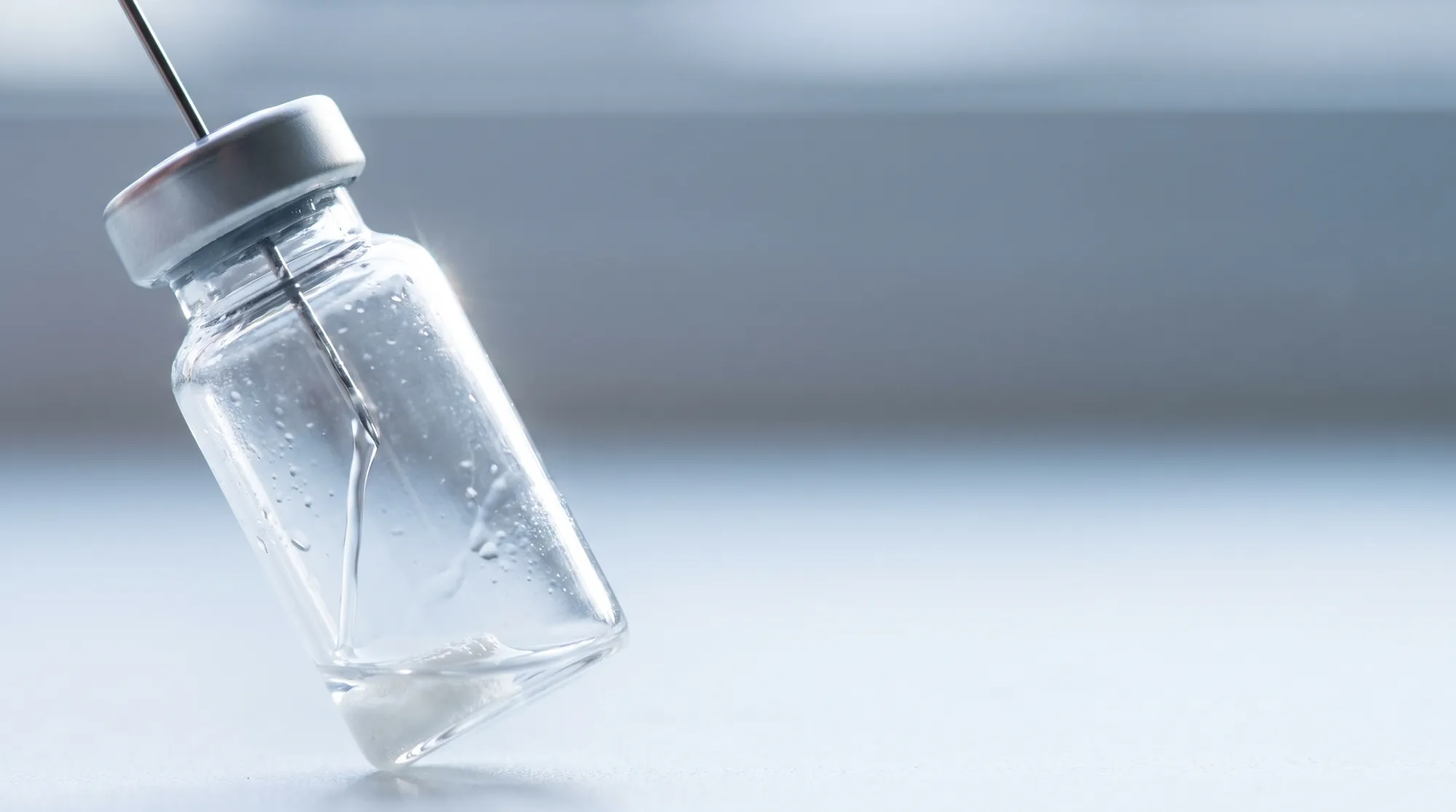
How To Mix A Vial
Lyophilised peptide arrives as a dry cake or powder under vacuum. Reconstitution is the act of dissolving that cake into a known volume of sterile diluent so that a measurable fraction of it can be withdrawn.
Which water to use
Bacteriostatic water is sterile water containing roughly 0.9% benzyl alcohol, which suppresses microbial growth and makes multi-draw vials viable for a matter of weeks under refrigeration. Sterile water for injection contains no preservative and is generally reserved for single-draw work. A handful of compounds — copper peptides and some acetate salts among them — have documented compatibility quirks with benzyl alcohol, so check the compound profile before defaulting.
Step by step
- Let the vial reach room temperature before opening. Cold glass plus cold powder makes for slow, incomplete dissolution.
- Swab both stoppers with isopropyl alcohol and let them dry.
- Draw the diluent, then angle the needle so the stream runs down the inner wall of the vial rather than jetting directly onto the cake. Peptide bonds are mechanically fragile.
- Let the vacuum pull the diluent in; don't force the plunger.
- Swirl gently or let it sit. Never shake. Agitation shears peptide chains and denatures them.
- Wait until the solution is completely clear. Persistent cloudiness or visible particulate after several minutes means something is wrong — don't proceed.
The maths
volume per dose (mL) = dose (mg) ÷ concentration (mg/mL)
syringe units (U-100) = volume (mL) × 100
The diluent volume is a free choice, and it is the only lever you have over measurement precision. A 5 mg vial in 1 mL gives 5 mg/mL, which puts a 250 mcg dose at 5 units — legible, but every half-unit of error is a 10% dosing error. The same vial in 2.5 mL gives 2 mg/mL and puts that dose at 12.5 units, where the same absolute error matters far less. Dilute enough that your target lands somewhere in the mid-range of the barrel.
Reading Your Syringe
Everything on this site assumes a standard 1 mL U-100 insulin syringe — the ordinary kind, marked 0 to 100. The U-100 label means it is calibrated for insulin at 100 units per millilitre, and that is what fixes 1 unit at 0.01 mL.
This is where most people go wrong. A unit is a volume, not an amount of peptide. Ten units drawn from a weak mix and ten units from a strong one fill the syringe to exactly the same line — but one holds five times more peptide than the other. That is why the calculator always asks what you put in the vial.
| What it says | What it means |
|---|---|
| U-100 | The calibration. 100 units of insulin per millilitre — which is what fixes 1 unit at 0.01 mL. |
| 1 mL | The barrel holds 1 millilitre in total, marked out as 100 units. |
| 1 unit | 0.01 mL. A hundredth of the barrel. This is a volume, not an amount of peptide. |
| 1–2 units | The smallest gap between marks, so the smallest amount you can measure with confidence. |
The unit chain
Four units of measure show up constantly and they are not interchangeable:
- mg — milligram. Mass. What vials are labelled in.
- mcg (µg) — microgram. 1 mg = 1000 mcg. What most non-GLP-1 research doses are expressed in.
- IU — international unit. A biological activity measure, not a mass. Conversion to mg is compound-specific: growth hormone is conventionally ~3 IU per mg, hCG is a different scale entirely. Never assume a universal factor.
- Syringe units — the marks on the barrel. 1 unit = 0.01 mL. Tells you nothing on its own until you know how strong your mix is.
Storage & Stability
Lyophilised peptide is comparatively robust: kept dry, dark, and at −20 °C, most compounds in this database are stable for a year or more, and many tolerate 2–8 °C for months. The moment water is introduced, that changes.
| State | Temperature | Typical window | Notes |
|---|---|---|---|
| Lyophilised, sealed | −20 °C | 12–24 months | Protect from light and moisture |
| Lyophilised, sealed | 2–8 °C | 1–3 months | Acceptable short-term |
| Reconstituted, bacteriostatic | 2–8 °C | 2–4 weeks | Compound-dependent; some far shorter |
| Reconstituted, sterile water | 2–8 °C | ~24 hours | No preservative — single session |
| Any state | Room temp | Hours | Degradation accelerates sharply |
Practical points
- Do not freeze a reconstituted vial. Ice crystal formation and repeated freeze–thaw cycles are among the most destructive things you can do to a peptide in solution.
- Copper peptides (GHK-Cu) and several others are photosensitive. Amber vials or foil, not a clear vial on a shelf.
- Store vials upright, away from the fridge door where temperature swings are largest.
- Date the vial at reconstitution. Memory is not a stability record.
- Cloudiness, colour change, or visible particulate that develops after a clear reconstitution means the solution has failed. Discard it.